The inventory
Everything in the box, counted.
Software pages usually say "powerful automation" and leave you guessing. This is the actual list of what gets built into your account, so you can check it against whatever you are using now.
Pipelines
Three boards, because a person can be more than one deal.
The same human can buy from you, sell to you two years later, and refer their sister in between. So the person is a contact, and each deal is its own card on the right board.
New lead to closed
New Lead, AI Qualifying, Contacted, Consult Booked, Showing, Offer Submitted, Offer Accepted, Nurture, Lost.
Valuation to signed
Valuation Lead, AI Qualifying, Contacted, Listing Appointment, Agreement Signed, Listing Active, Offer Received, Offer Accepted, Nurture, Lost.
Under contract to post close
Under Contract, Earnest Money, Inspection, Appraisal, Loan, Clear to Close, Closed, Post Close. A deal moves here automatically when the offer is accepted.
The record
47 fields on the contact, 30 on the deal, filed in folders.
Facts about the person live on the person. Facts about one transaction live on that transaction. That sounds obvious and almost no CRM does it, which is why most agents end up with a contact record holding four different addresses.
Lead and source
Where they came from, who referred them, what they are trying to do, which open house they walked, and the consent record.
Property
Their address, type, beds, baths, square feet, whether they own or rent, the last automated value and when it was taken.
Buyer profile
Price range, timeline, pre approval status and lender, areas, must haves, and whether this is their first purchase.
Seller profile
Reason for moving, target date, whether the home is owner occupied, and whether they need to buy at the same time.
Key dates
Closing, inspection, appraisal, loan contingency, purchase anniversary. These are the fields the reminders fire from.
Client details
Partner name, best time to reach them, preferred contact method and language.
The fields you filter a board by daily are proper dropdowns, so filtering works. Everything else is free text, so nobody is fighting a picker at 9pm.
Automation
24 campaigns, already written.
Every one is a normal editable workflow in your own account. Rewrite any of them. The point is that none of them start as a blank page.
| Lane | What runs |
|---|---|
| Speed to lead | The five minute ladder: email, text, AI call, then five more touches across the first week. |
| After hours | The quiet hours version. Email now, everything else at 8am, so nobody gets a text at midnight. |
| AI booked | The assistant booked them. Confirmation, prep, and what to bring. |
| AI seller | The assistant found a seller. Routes to the listing appointment track instead of the buyer one. |
| Missed call | Thirty seconds after a call you did not answer, a text goes out asking what they need. |
| Appointments | Reminders at 24 hours and 2 hours, on both email and text. |
| No show | They did not turn up. A recovery message, then up to two rebook attempts, then nurture. |
| Buyer nurture | Twelve monthly touches for buyers who are not ready yet. |
| Seller nurture | Twelve monthly touches for homeowners thinking about it. |
| Nurture exit | The safety net. Someone replies or books, and every nurture track lets go of them. |
| Client guard | Stops marketing reaching anyone who is currently a client. The single most important workflow here. |
| Valuation lead | A homeowner asked what their home is worth. Delivery, then the seller ladder. |
| CMA delivery | Builds the valuation document, sends it, and tells you the moment they open it. |
| Open house | Same evening follow up naming the property they walked through, then a three touch sequence. |
| Market report | The monthly market note to your sphere, with your own numbers in it. |
| Listing kit | What fires when a listing goes active: the seller update rhythm and the marketing checklist. |
| Transaction: inspection | Deadline reminder before the inspection contingency. |
| Transaction: appraisal | Deadline reminder before the appraisal. |
| Transaction: loan | Deadline reminder before the loan contingency. |
| Closing: 7 days | The week out checklist to the client and to you. |
| Closing: 3 days | Wiring, walkthrough, utilities, keys. |
| Closing day | The morning of, and the congratulations. |
| Review and referral | Review ask at three days, referral ask at three weeks. |
| Anniversary | The purchase anniversary, every year, on the date, forever. |
Underneath these sit 38 routing automations that do the filing: moving a card when a tag lands, syncing a date onto the deal, sending an offer acceptance across to the transaction board. You will never open those, and that is the idea.
Capture and calendars
The things your leads and clients actually touch.
Two forms
Open house check in, built for a phone at the door, with the property stamped on automatically by the QR code you print. And a buyer or seller intake for people ready to talk properly.
- Consent language written for texting and calling law, stored on the record as an audit trail
- The source of every submission recorded, so you can tell which open house worked
- A next visitor button on the thank you screen, so the phone resets itself at the door
Three calendars
Buyer Consult, Listing Appointment and Showing, each with its own link, its own duration and its own reminder rhythm.
- The AI assistant books straight into them
- Every campaign links to the right one, not to a generic "book a call"
- Round robin ready if you add a partner or an assistant later
The valuation engine
The part a homeowner reads.
Address in, document out. It is the strongest seller lead magnet in the business and the most dangerous thing to get wrong, so this is exactly what it does and does not claim.
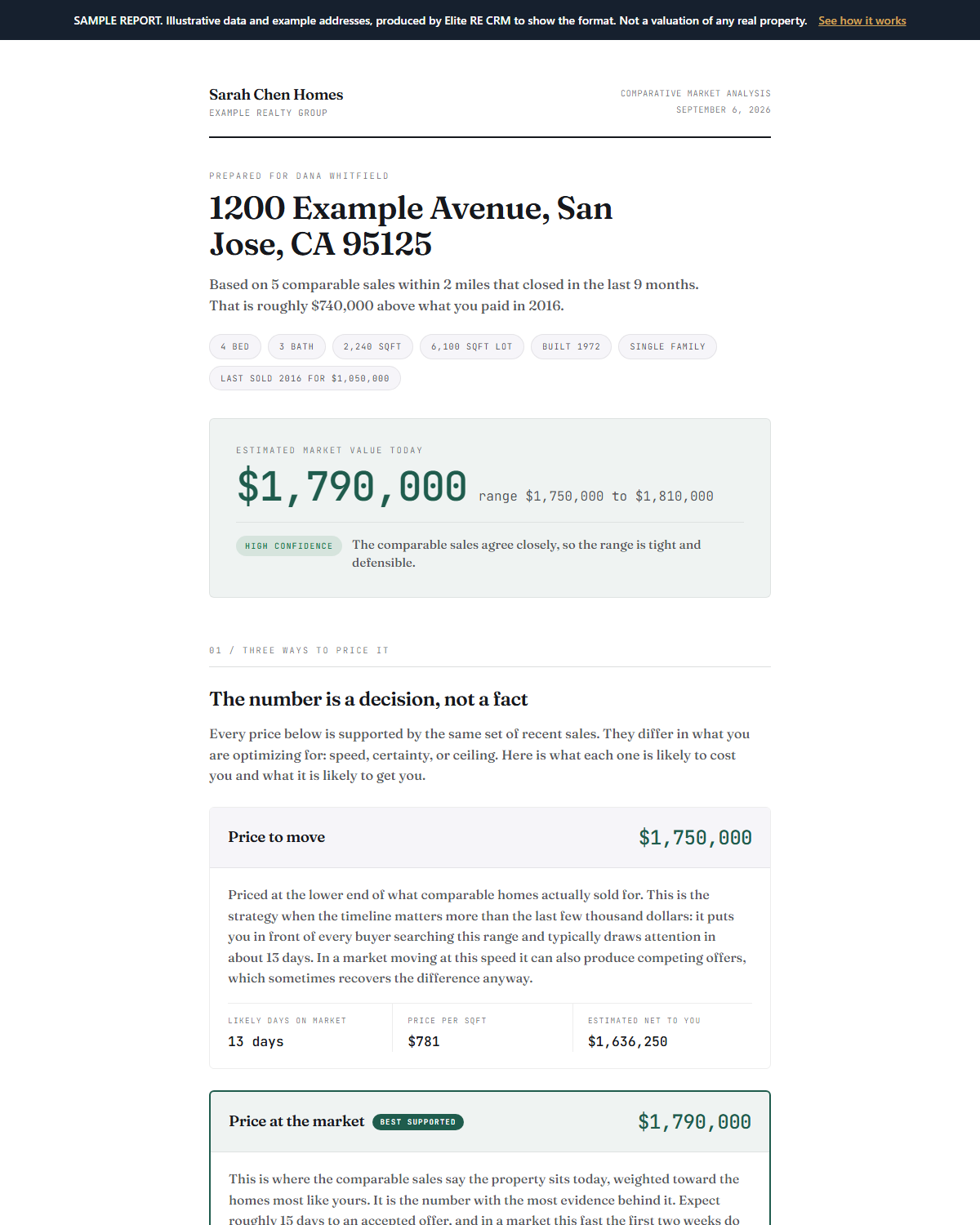
The real thing. Illustrative addresses, real engine. Open the full report.
What the document contains
- An automated valuation estimate with its confidence range
- Comparable recent sales nearby, with their details
- Local market statistics: median price, days on market, inventory
- An estimate of net proceeds after commission and closing costs, using your own rates
- Your name, your photo, your contact details, your booking link
What it says about itself
- That the estimate is computer generated, not an appraisal, and not a promise of sale price
- The Equal Housing Opportunity statement
- Your license line, and if you have not given us one, no license line at all rather than a wrong one
- Nothing about schools, safety, or who lives in an area, anywhere in it
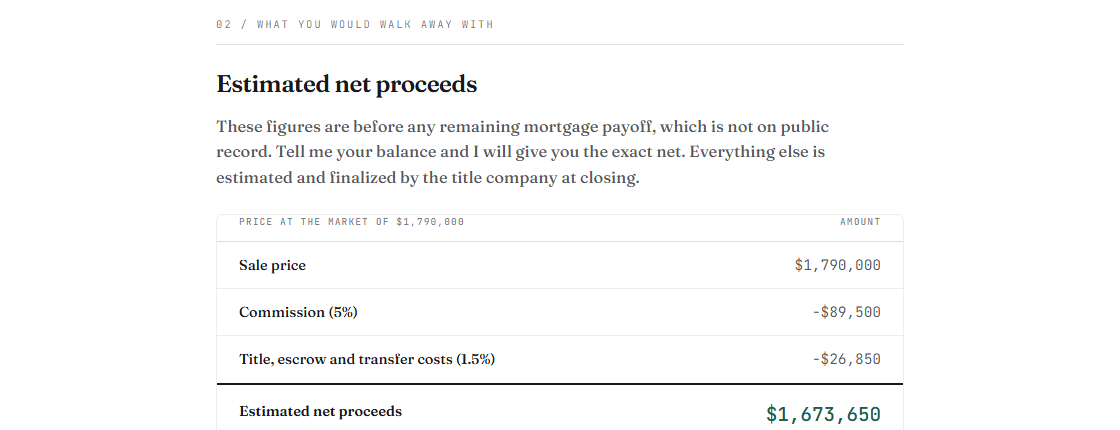
The net sheet. What they actually walk away with, not just the headline price.
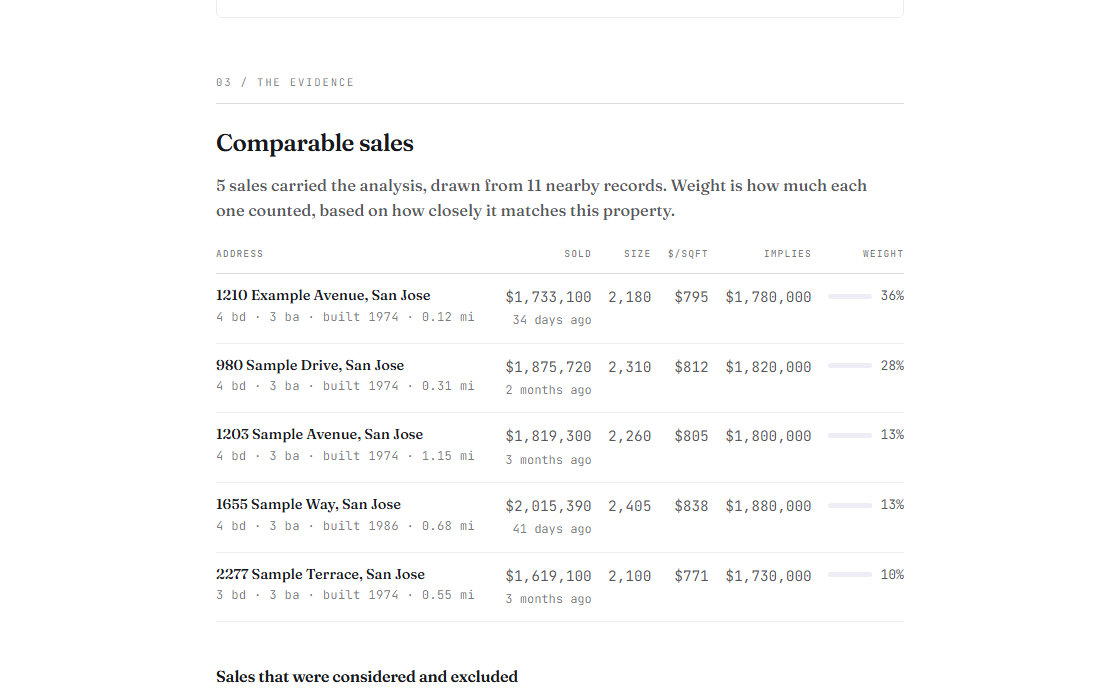
The comparable sales. Every one scored for how closely it matches.
Property data comes from a licensed third party provider of automated valuations and market statistics, running on your own free account with that provider, set up during onboarding. It is not an MLS feed. That is a different thing and it is a separate $100 add on: the valuation engine values a home from public records, the listing search shows what is for sale. Neither replaces the other.